
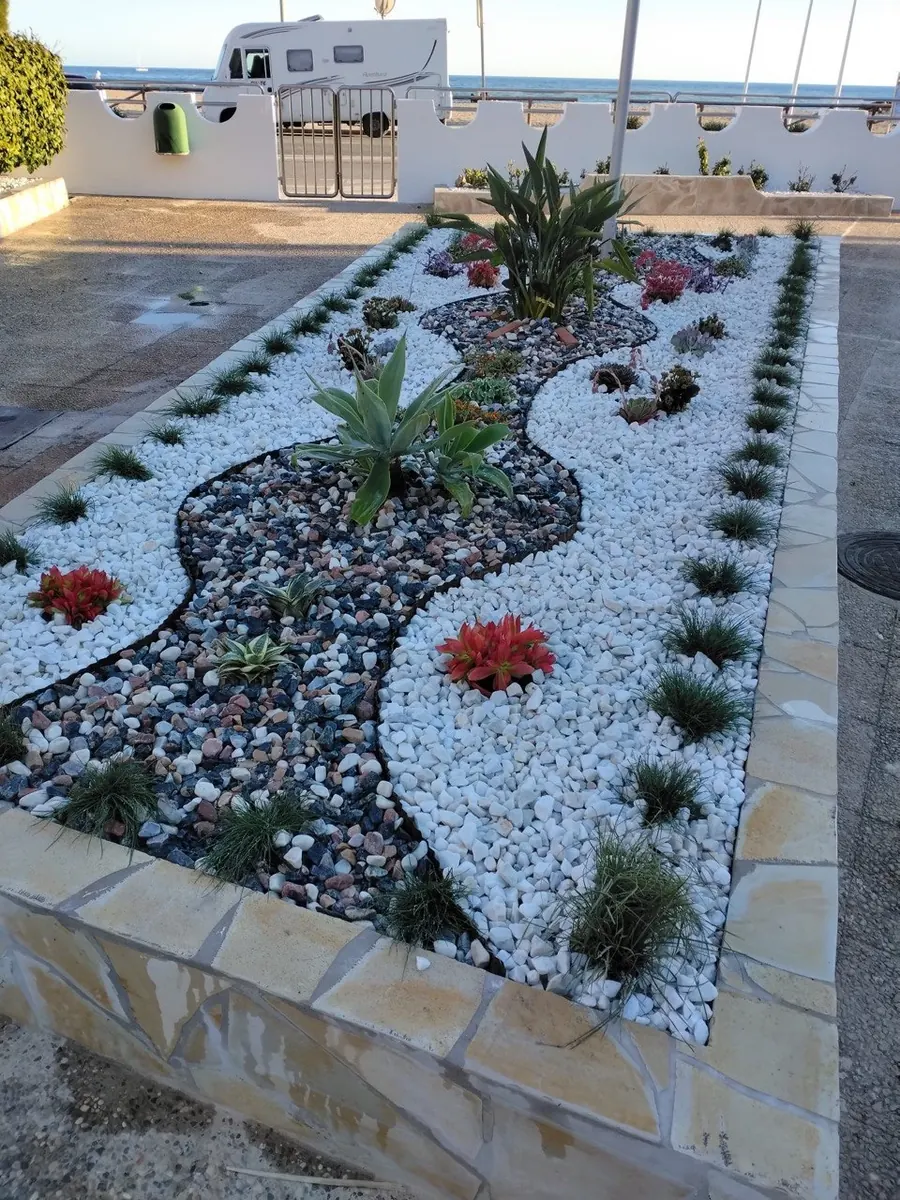
Many villa owners across Mazarrón, Bolnuevo, and Camposol debate between installing a traditional grass lawn or investing in a full Mediterranean xeriscape conversion with decorative gravels, geotextile weed barrier, and drought-tolerant planting.
Here is a 3-year agronomic and financial comparison for a typical 200 m² villa garden area.
1. Annual Water Consumption Breakdown
Water tariffs in coastal Murcia are tiered, meaning high consumption triggers significantly higher rates per cubic metre.
| Parameter | Traditional Grass Lawn | La Mimosa Gravel Xeriscape |
|---|---|---|
| Daily summer water demand | 6 – 8 litres / m² / day | 0.8 – 1.2 litres / m² / day |
| Total annual water use (200 m²) | 380 – 450 m³ / year | 45 – 60 m³ / year |
| Estimated annual water cost | ~€950 – €1,200 / year | ~€110 – €160 / year |
| Net water savings | — | 87% water bill reduction |
2. Maintenance Time & Upkeep Costs
Traditional Lawn:
- Weekly mowing from April to October (28–32 cuts per year).
- Continuous fungicide applications against summer fungal outbreaks caused by heat and night humidity.
- Autumn overseeding, scarifying, and frequent sprinkler head repairs.
- Time commitment: 4 to 6 hours per week.
Gravel Xeriscape with Acclimated Flora:
- Geotextile weed membrane blocks 98% of weed growth.
- Light shrub shaping twice a year.
- Occasional leaf raking over decorative marble cobbles.
- Time commitment: 1 to 2 hours per month.
3. Return on Investment (ROI) & Conclusion
The initial investment in heavy-duty edging, professional geotextile membrane, decorative aggregates, and a zoned pressure-compensating drip system typically pays for itself in 18 to 24 months purely through accumulated water bill savings and reduced garden maintenance costs.
Beyond the financial savings, a gravel rockery looks immaculate 365 days a year without the unsightly dry or patchy yellow appearance that coastal grass suffers during July and August heat spikes.